Perhaps the most prominent learning design model is the “Instructional Design”, also known as Instructional System Design. By definition, Instructional Design “is intended to be an iterative process of planning outcomes, selecting effective strategies for teaching and learning, choosing relevant technologies, identifying educational media, and measuring performance” (Branch & Kopcha,2014, p. 77). According to David Merrill (2002), “Instructional Design” is the process of creating learning experiences that makes the acquisition of skill more appealing, effective, and efficient. The foundation concept of the Instruction Design model refers to “the systematic and reflective process of translating principles of learning and instruction into plans for instructional materials, activities, information resources, and evaluation” (Smith & Ragan, 2005, p. 4).
The instructional design process consists of determining the needs of learners, defining the end goals and objectives of instruction, designing and planning assessment tasks, and designing teaching and learning activities to facilitate learning most effectively (Rodrigo, Iniesto & García-Serrano, 2020). As a well-defined approach to the design of e-learning processes, instructional design follows specific systematic approaches and learning theories to understand, explore, create, and evaluate situations requiring educational interventions and using educational technology as a method to support them (McDonald & West 2020).
There are numerous instructional design models used in different contexts each of which combines both theoretical aspects and practical information from field experience to help instructional designers create the most compelling and effective courses (Arshavskiy, 2017). Among several models that learning designers acknowledge and use to visualize, direct, and manage the learning process, the most widely used the in e-learning context are the ADDIE Model, Merrill’s Principles of Instruction, Bloom’s Taxonomy, and Gagne’s Nine Events of Instructions.
ADDIE refers to the instructional development process comprising five phases: Analysis, Design, Development, Implementation, and Evaluation in that particular order (Yeh & Tseng, 2019).
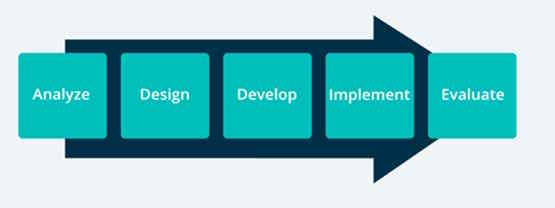
Figure 1. The Original ADDIE Model in Linear Structure, Starting with Analysis and ending in Evaluation (Source: Research.com, 2022)
The original goal of the ADDIE model is to increase the effectiveness and efficiency of results in choosing solutions to instructional problems. According to Molenda et al. (1996), the original version of the ADDIE model worked well for the business, military, and continuing education settings as well. Considerable research discusses the relationship between e-learning and ADDIE and how their combination will deliver e-learning content successfully in academic, training, and business education contexts.
| ADDIE Model’s Phases | Description | Examples used in e-Learning |
| 1. Analysis | The analysis phase is the “Goal-Setting Stage”. The designer validates the performance gap and determines instructional goals. | · The analysis phase clarifies instructional problems and objectives and identifies the learning environments, and the learners’ existing knowledge and skills. |
| 2. Design | The focus is on learning objectives, content, subject matter analysis, exercise, lesson planning, assessment instruments used, and media selection. | · The design phase deals with learning objectives, assessment instruments, exercises, content, subject matter analysis, lesson planning, and media selection. |
| 3. Development | This stage starts the production and testing of the methodology being used in the project. Development also involves creating and validating learning resources and learning outcomes. | · In the development phase, instructional designers and developers create and assemble content assets blueprinted in the design phase |
| 4. Implementation | The implementation stage reflects the continuous modification of the program to make sure maximum efficiency and positive results are obtained. | · The implementation phase develops procedures for facilitators and learners. |
| 5. Evaluation | The main goal of the Evaluation stage is to assess the quality of the instructional products and processes, both before and after implementation | · The evaluation phase consists of two aspects: Formative and summative evaluation. |
